
Smarter Config Restores. Safer Networks.
Restore exactly what you need, from a single configuration snippet to a full device, using the granular, device-aware Config Restore engine in rConfig V8.0.2.
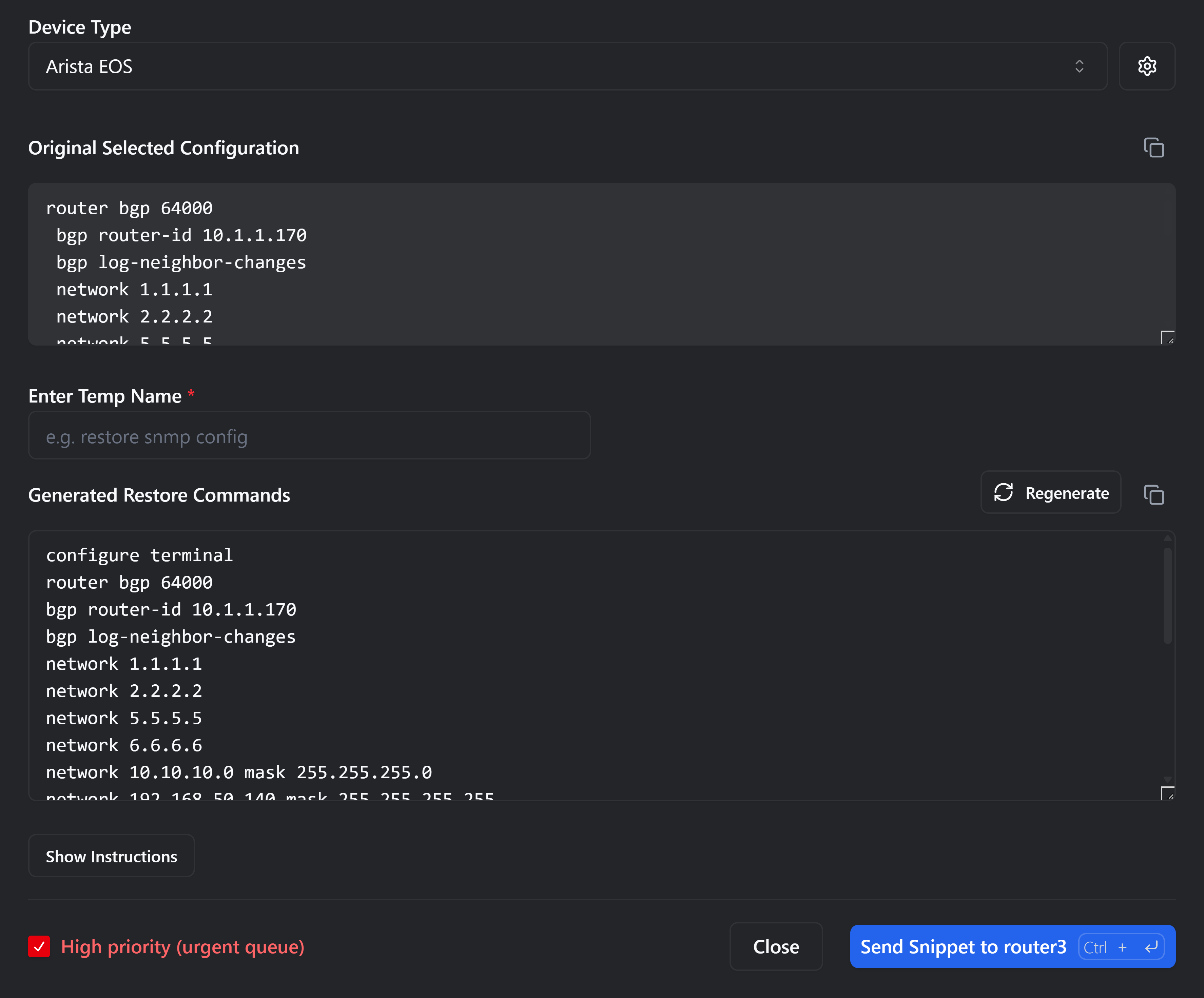
Granular Control. Powerful Restoration.
Gone are the days of all-or-nothing rollbacks. rConfig V8.0.2 introduces a precision engine designed for modern, complex networks.
Restore Only What You Need
Select specific configuration blocks (interfaces, ACLs, routing tables) or commit full device configs. Surgical precision prevents overwriting unintended changes during recovery.
Device-Aware Commands
Automatically includes correct entry, save, and exit commands per vendor.
write mem / commit / saveCustom Device Profiles
Define restore logic for any platform. Custom drivers for legacy or niche hardware ensure full coverage.
High-Priority Restore Queue
Elevate urgent restores during outages or service degradation. The queue manager ensures critical infrastructure gets priority processing over routine backups.
How Config Restore Works
Precision is key in disaster recovery. rConfig’s restore engine isn’t just a text dump; it’s an intelligent orchestration layer that understands the difference between a Cisco IOS router and a Juniper firewall.
Every restore event is fully audited for compliance (ISO/NIST), ensuring you know exactly who restored what, and when. The integrated version history allows you to diff against the live state before committing any changes.
Under pressure, that same precision extends to how work gets prioritized: urgent restores can jump ahead of routine backups in the queue, and custom device profiles carry the same vendor-aware logic to legacy or niche hardware most tooling doesn’t recognize out of the box.
1. Config Selection
Choose a snippet, block, or entire configuration from the visual diff/restore interface.
2. Restore Generator
System auto-builds vendor-specific commands (conf t, write mem, commit) based on the device profile.
3. Device Profiles
Logic templates ensure commands match the OS version and syntax requirements of the target hardware.
4. Audit & Queue
Execution is logged with actor identity and timestamp. Priority queue handles the dispatch.
See Config Restore in Action
Watch how engineers restore full configs, specific sections, or emergency commands in seconds using rConfig’s device-aware restore generator.
Config Restores Built for Real Networks
Operational resilience when you need it most.
Rapid Recovery in Outages
Restore only core routing or interface blocks to bring devices back online safely, without overwriting stable config sections that rely on uptime.
Restore Interface Configs
Apply targeted restores to affected interfaces during a misconfiguration event, avoiding cascading failures across the wider network topology.
Reverse Access Errors
Roll back only the ACL entries that caused the connectivity loss, instantly restoring traffic flow while preserving the rest of the security posture.
Frequently Asked Questions
Common questions about network configuration restore workflows.
What is the Config Restore feature in rConfig?
Config Restore in rConfig V8.0.2 is a granular recovery engine that allows network engineers to restore specific parts of a device configuration (like an interface or ACL) or the entire configuration. It generates vendor-specific commands to ensure safe application.
How is Config Restore different from Rollback/Version Control?
Traditional rollback often overwrites the entire device state, which can be risky on live networks. Config Restore leverages Version Control data but gives you the option to selectively apply 'snippets' or 'blocks' of code, making it safer for surgical repairs during outages.
Can I edit restore commands before sending them?
Yes. rConfig provides a review stage where the generated script (including entry/exit commands like 'conf t' or 'write mem') is presented. You can edit, add, or remove lines before the system pushes them to the device.
Does Config Restore work with all network device types?
It works with any device that has a defined Device Profile in rConfig. The system supports multi-vendor environments (Cisco, Juniper, HP, Fortinet, etc.) out of the box, and custom profiles can be created for unique hardware.
Is every restore logged for compliance?
Absolutely. Every restore action is recorded in the immutable audit log, capturing who initiated the restore, the exact code sent, the device response, and the timestamp. This is essential for ISO and NIST compliance.
Can I prioritize urgent restores?
Yes, the High-Priority Restore Queue allows admins to flag critical restore jobs. These bypass the standard scheduler queue to be executed immediately, minimizing downtime during major incidents.
Start Managing Restores Like a Pro
Avoid misconfigurations, reduce downtime, and restore safely with granular, vendor-aware configuration recovery.
No credit card required for trial. Setup in 5 minutes.